


Her first virtual view, spun in orbit, was from Jane’s Market Forces—a publicly available, but prohibitively expensive, real-time survey of military deployments around the world.
Myra, long familiar with the conventional symbols and ideographs, took it all in at an abstract level: colour-coded, vectored graphs in a 3-D space, with other dimensions implied by subtle shadings and the timing of pulsations. That photic filigree hung like a complicated cloud-system over the relatively static histograms depicting the hardware and the warm bodies.
-Ken MacLeod, The Star Faction
OSINT (Open-Source) Intelligence Tools collate publicly-accessible information to generate actionable intelligence. I don’t know a lot about this field but was tempted to try one.
My motivation was a wish to have a dashboard, a single pane overview of global affairs. Salient information I can rapidly consume in addition to my other information-gathering processes with the facility to drill into the detail of anything I’d like to know more about. The tool I decided to try is Crucix.
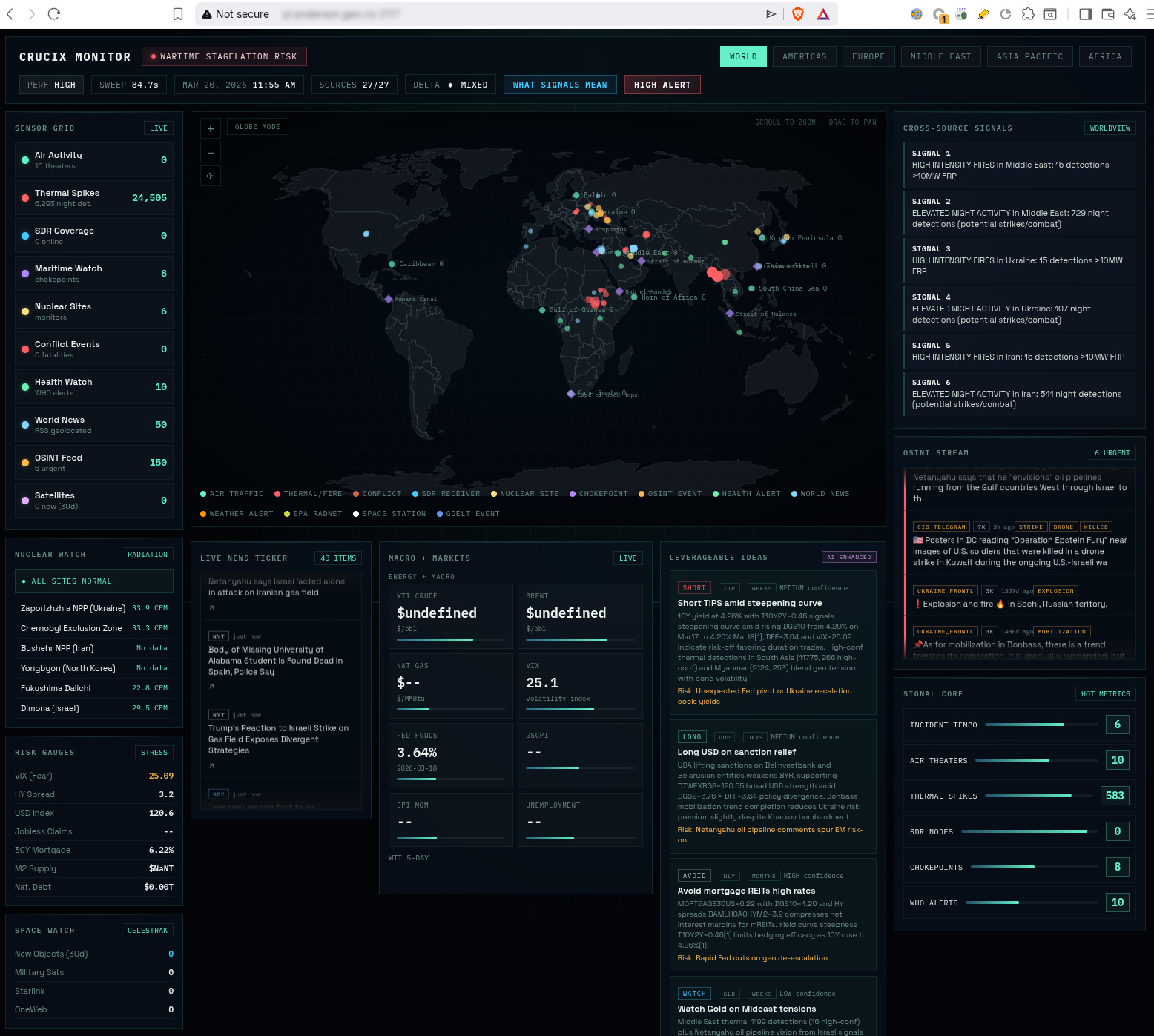
Crucix runs locally on my own hardware, pulling in news articles, satellite imagery, radiation levels, conflict events, economic indicators, flight tracking, maritime activity, social media content and market data. It displays this information on a 3D globe featuring fire detections, air traffic, radiation sites, maritime chokepoints, SDR receivers, OSINT events, health alerts, geolocated news and conflict events. Alongside this are risk gauges and news tickers.
Out of the box Crucix provides me with a single-pane overview of world affairs. I could customise it (and probably will) by configuring it to consume other data feeds that are of specific interest to me. For now it suffices, appropriate for a world/regional overview rather than a local news aggregator.
But that is not all Crucix does. Because it plugs into my choice of LLMs it has the capacity to reason and to interact.
One of those reasoning capabilities is financial trading. Right now Crucix is advising me to short Treasury Inflation Protected Securities and go long on U.S. Dollars, and explaining its rationale. A little further down Crucix is evaluating the pricing trends in the gold market. One of the factors it used to reach its trade recommendation is the heat map of detected explosions in the Middle East it pulled from satellites.
Crucix is performing these evaluations in real time and if it thinks it’s urgent, notifies me.
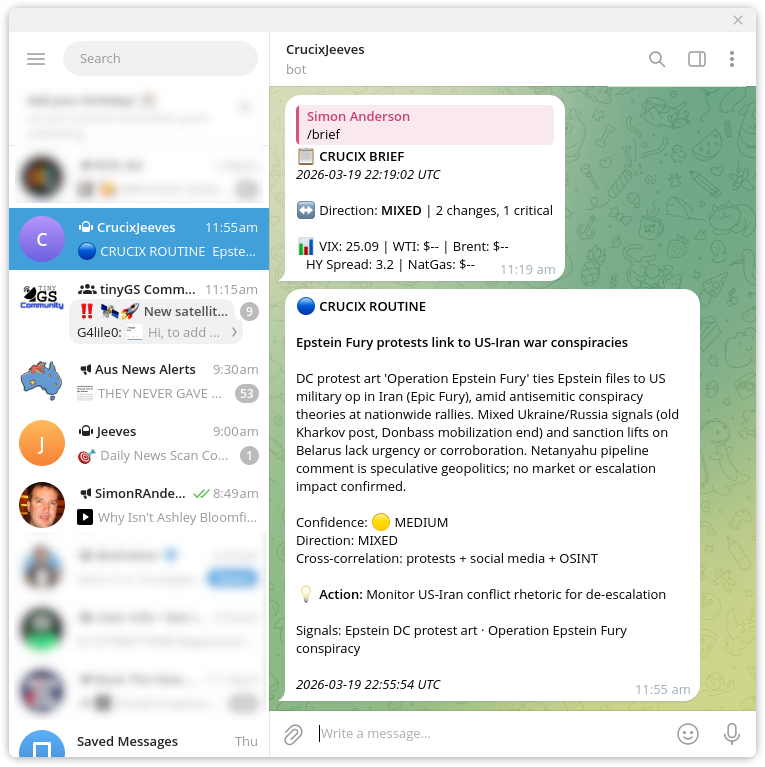
Like many Agentic AI solutions Crucix has a messaging capability through the Telegram platform. In the screenshot above is its response when I’ve asked for a brief summary, and a synopsis of topics it thinks I should know about that it sent me unprompted.
So far so good. I have a tool which aggregates information from a vast array of sources and presents it to me in a readily consumable format. The tool is capable of analysing that data in useful ways and interacting with me when I need it to do something.
But Crucix is not perfect. The code is a little rough and I’d need to get under the hood to adjust its behaviour or integrate it with other tools, for example to perform automated trades based upon its recommendations. It’s no Palantir but it is an incredibly useful tool accessing freely available sources. In a day it’s superseded every other information harvesting process I’ve used previously to provide my global overview.
With the advent of AI, tools such as Crucix will proliferate thanks to the Free Software and Open Source communities building them. They’ll service increasingly specific niches and improve rapidly but in the state they are now, they feature astonishing capabilities. Not so long ago, tools such as Crucix were science fiction.
-SRA. Auckland, 20/iii 2026.
Nota bene: the title of this article is a quote from the novel The Star Faction by Ken MacLeod. Crucix reminded me of the description he wrote 30 years ago. Here it is in full:
Her first virtual view, spun in orbit, was from Jane’s Market Forces—a publicly available, but prohibitively expensive, real-time survey of military deployments around the world.
Myra, long familiar with the conventional symbols and ideographs, took it all in at an abstract level: colour-coded, vectored graphs in a 3-D space, with other dimensions implied by subtle shadings and the timing of pulsations. That photic filigree hung like a complicated cloud-system over the relatively static histograms depicting the hardware and the warm bodies.
The physical locations and quantities of personnel and materiel could provide only a basement-level understanding of the world military balance, just as the location of physical plant was only a rough cut of the state of the world market.
Second by second, market and military forces shifted unpredictably, their mutual interpenetration more complex than any ideology had ever foreseen. With most of the world’s official armies revolutionary or mercenary or both, and most of the conflicts settled in unarguable simulation before they started, everyone from the bankers down through the generals to the grunts on the ground would shrug and accept the virtual verdict, and change sides, reinforce or retreat in step with their software shadows—all except the Greens, and the Reds.
They fought for real, and played for keeps.
It was like the old Civilization game, Myra sometimes thought, with a new twist: Barbarism II. Nobody was going to wipe the board, nobody was going to Alpha Centauri. They were all going down together, into the dark… Just as soon as enough major players decided to contest the incontestable, and put the simulations to the audit of war.
But, for the moment, the dark was full of twisting light. And in the real world, blinked up as backdrop, one front was more than virtual, and closer than she’d like. Beyond the northern border of Kazakhstan, itself hundreds of kilometres north of the ISTWR, the Sino-Soviet Union’s ragged front-line advanced in flickers of real fire: guerilla skirmishes and sabotage on one side, half-hearted long-range shelling and futile carpet-bombing on the other.
The Sheenisov—the name was subtly derogatory, like Vietcong for NLF and Yank for United Nations—were the century’s first authentic communist threat, who really believed in their updated version of the ideology which communistans like the ISTWR parodied in post-futurist pastiche. Based in the god forsaken back-country of recusant collective farms and worker-occupied factories, stubbornly surviving decades of counter-revolution and war, armed by partisan detachments of deserters (self-styled, inevitably, “loyalists’) from the ex-Soviet Eastern and ex-PRC Northern armies, they’d held most of Mongolia and Siberia and even parts of north-west China since the Fall Revolution back in 2045, and in the years since then they’d spread across the steppe like lichen.
Myra detested and admired them in equal measure.
Of more immediate, and frustrating, concern: the Sheenisov were outside the virtual world, a torn black hole in the net.
Their computers were permanently offline; their cadres didn’t trade combat futures; they refused all simulated confrontation or negotiation; like the Green marginals in the West and the Khmer Vertes in the South, the Reds in the East put all to the test of practice, the critique of arms.
Even Jane’s could only guess at their current disposition.
This is fascinating, as someone who spends many hours a day focusing on how modern warfare affects the international marketplace Crucix looks like a valuable and interesting tool. While I enjoy aggregating the information I imbibe daily myself, there's nothing like a good tool that saves time and gives a sense of direction. Perfect isn't necessary, a good tool doesn't have to be great to be of benefit, thanks Simon!