


Matua Kahurangi published an interesting piece today, describing his adventures on the Tiktok platform and some of the challenges he’s encountered. I think I’m quite well placed to offer a perspective.
In what I take to be his essential thesis Kahurangi writes:
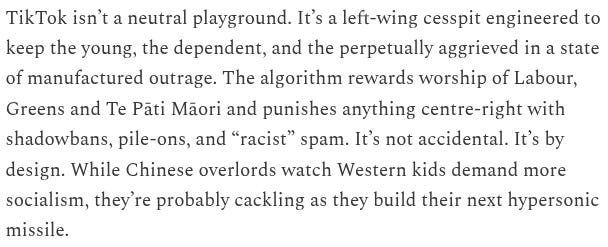
This is, largely, in my experience, accurate. A combination of algorithmic manipulation and audience preference results in a platform that tracks towards unedifying slop content and equally puerile leftwing biases. Of course this is anecdotal: ByteDance, the operator of Tiktok outside the United States, does not publish its algorithm publicly as enlightened platforms such as X choose to do.
Tiktok’s algorithmic selections for content promotion/demotion are however, obvious. Unlike many of the other social media platforms Tiktok doesn’t practice much subtly, as one might expect from a company accustomed to the constraints of the Great Firewall of China, ByteDance doesn’t much care if Tiktok’s users know they’re getting throttled if and when they are.
Kahurangi includes in his article a screenshot of his first week on the Tiktok platform, showing a view count of one million views. An impressive amount, and a testament to the demand for humorous AI-generated content. In contrast, the sort of content I produce gains nowhere near that amount of traction:
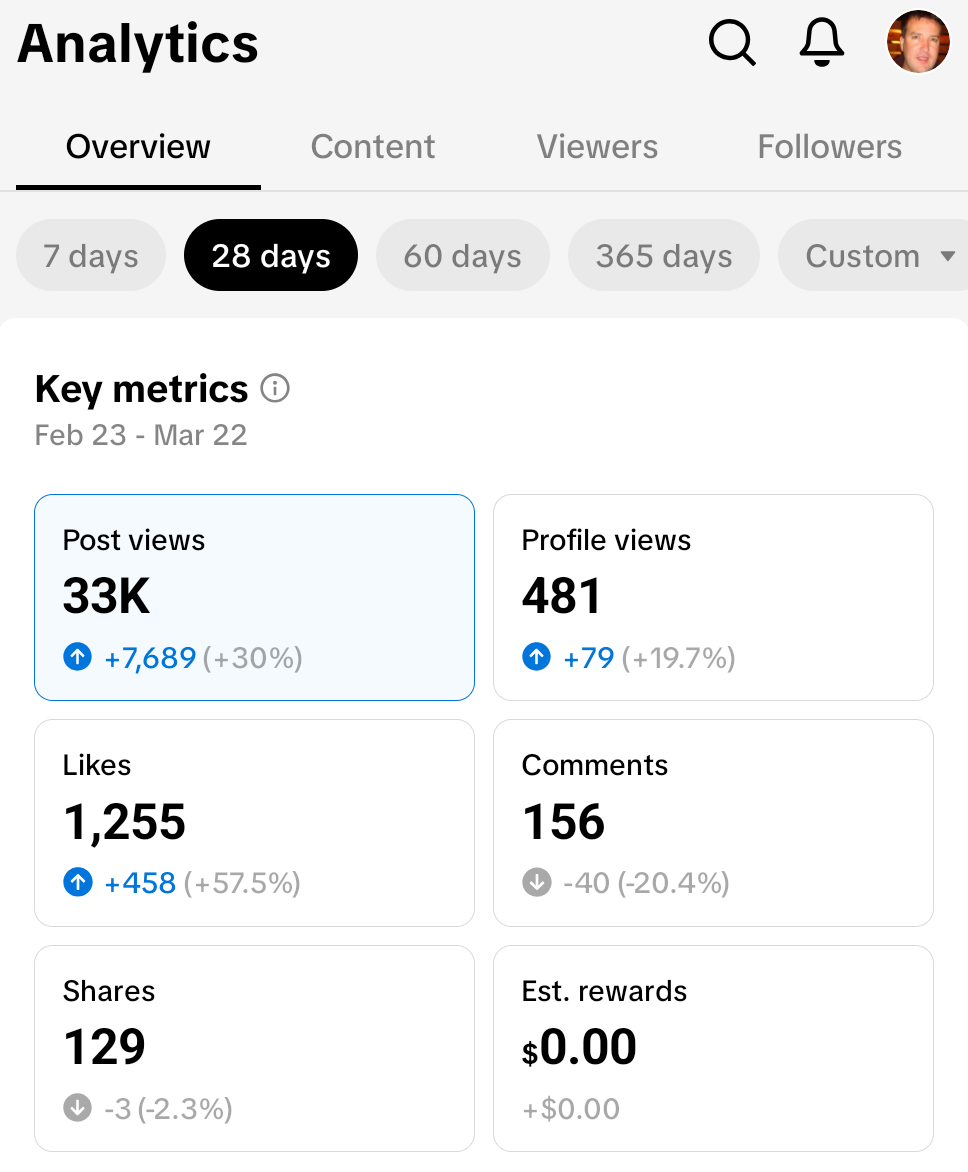
I can offer a broad perspective however. Because the content I produce (livestreams, short clips from those livestreams, diatribes to camera, hyper-local news content from central Auckland) is posted across a variety of platforms I can observe which clips gains traction and where. It is largely a mystery, some clips get picked up on one platform but struggle on others for no apparent reason. Trends can be observed though.
The platforms I post to are X, Youtube, Rumble, Instagram/Facebook, Tiktok, Substack, Telegram and very occasionally, LinkedIn. Typically clips go viral on just one or two platforms and it’s interesting to observe as tens of millions watch on Instagram, hundreds of thousands watch on X, and merely a few thousand watch on Youtube and Tiktok -which is precisely what happened with a clip I published late last year.
There are many factors influencing traction of course but the algorithm plays a significant part. I struggle with Youtube, where I’ve been shadowbanned as a punishment for questioning the veracity of the anthropogenic climate change narrative, watching my livestream viewcounts fall precipitously from thousands to the hundreds. Youtube’s AI heard me question global warming fairy-tales in a livestream and has demoted me since. I know this to be true because I mentioned it again deliberately and watched my channel get demoted further.
As I mentioned above Tiktok’s algorithm is much more blatant and to be blunt, crude. Occasionally I’ve published footage of the Falun Gong marching in central Auckland, a movement proscribed by the Chinese Communist Party. Clips which mention Falun Gong in the title are instantly flagged, those that don’t are often flagged through AI content analysis subsequently though occasionally slip through.
The title matters a lot to Tiktok’s algorithm. I’ve found that if it includes a topic ByteDance is favourable towards it tends to get promoted, even if the content itself is in fact critical. One of my most successful clips on that platform for example excoriates Chloe Swarbrick -promoted because the title includes her name but despite the actual content. I’ve observed the same to be true for other contentious issues with clips including the terms “Green party” “Waitangi” and “Jacinda Ardern.” I’m firmly of the belief that ByteDance has a political agenda tailored for New Zealand that its algorithm encourages.
Consumer preferences matter though. The userbase of Tiktok tracks younger than other platforms. Less educated, less affluent, superficially informed, more ethnically diverse. And of course many are seeking entertainment over edification which is entirely legitimate. In my opinion this userbase is particularly susceptible to manipulation whether practised by ByteDance on behalf of the Chinese Communist Party or domestically by the far-left politicians in New Zealand producing puerile content tailored to their limited attention spans.
In my experience the most unbiased platforms are X and Substack, with Rumble close behind. All platforms practice algorithmic manipulation to some degree and because it’s mostly opaque it’s difficult to assign cause to it or to human nature. And besides, it may be (and probably is) the case I’m not producing content that enough people find interesting.
The pressure for content creators seeking to grow their audience is to comply. Comply with the algorithmic constraints, comply with audience tastes. Doing so can come at the cost of authenticity and the imposition of self-censorship. The creators I admire the most are those who choose not to sully themselves through making that bargain.
-SRA. Auckland, 24/iii 2026.
Good read! Let's build an algorithm-friendly slop (video/text/images) with hidden encrypted content to reach millions ... notifying how to decrypt the real content is the trickier part... I'll leave the details to you :)